Textiles & sustainability
|
|
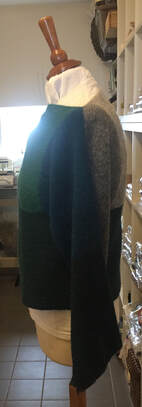
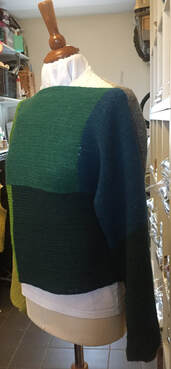
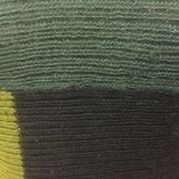
2023: The execution of my first business model under Vera Design is in terms of recycling the production in three steps. Step A: Main textile designing of scarves with fresh yarn. Step B. Design s from unsold stock. Step C: Weave products with the left over yarn. This three step procedure takes about a year to do with the big question left of how much material will still be left for free creation or spinning new yarn. The making of a new product in step B is a development procedure where of course the best outcome would be to unravel the least of the already knitted fabric. The sweater on the left is my best outcome yet, reversible *no seams), light and not too tight. I hope to develop numerous standard cuts that have the same ,,easiness`` around them, not too complicated to make and fun to wear. Marketing is still unresolved but a Shopify page is in the making that will be linked to this homepage.
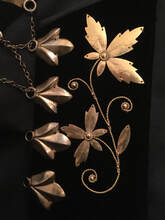
2021: I found a business model to my liking Slow Fashion that seems to embrace better my former ideas of sustainable fashion than before and gives a good idea how to reach the objects of e.g. the NICE project. ,,With the Slow Fashion´s Business Model a new vision is on the fashion industry of sustainability where fashion and the customer´s happiness is linked with knowledge and responsibility. It is about choices, information, cultural diversity and appearance that involves the equilibrium of economy or the ecology system. With Slow Fashion the designer has to regard his choices of material, design a ,,time-less” fashion that is applicable any time. The focus is rather on quality than quantity, with concerns about ecological production and that it lasts longer because of it. The ,,under pressure” mentality of production in general is thus eased up. (Alda Kristín Sigurðardóttir, 2011, page 31)
Sustainability is said to be different from other economic policies in the world because of it´s long time planning. The most interesting aspect about that is I would think might be the cultivating factor, the possibility of creating one own´s fabric for designing purposes. But sustainability can have so many other forms like I discovered at Iceland´s design festival Hönnunarmars were the first steps towards selfsustainability in clothing design were advertised to have been taken. Mannequins in beautifully designed white linen were in the window of that sustainable designer, that explained to me that the sustainability factor lied in a less complicated manufacturing procedure. She designed everything regarding her production in the computer that worked out just beautifully. No in between factors that delayed the manufacturing procedure considerably but was communicating straight with the factory that made the clothes. Less cost effective.
So textiles and sustainability have that many aspects to it that mixed together they combine a wonderful in-between way to make beautiful clothes and solving problems regarding it´s creation that have risen somewhere along the road in history. H&R experiments with recycling, artists using textiles in innovative ways and my determination to focus on patternmaking as my outlet for textile-making outlet has given in to a more profound thinking of the construction of weaving itself and it´s texture. To be quite honest I had never given it a second thought what the textile curriculum was i.g. in schools but as my first professional acquaintance with a textile person was through the ambition of creating excellent patterns these two concepts tied strongly in my mind.
2012: At the time when re-joining the Icelandic fashion association in Iceland in 2007 a very interesting project was being introduced within the society i.e. ,,The Nice project" in the Nordic House in Iceland. The whole idea about sustainability and ethical issues concerning fashion widened the dialogue about fashion in Iceland considerably also because of the educational factor. More discussion about textiles in Icelandic fashion is vital. Textiles bear such an ethnic sense to fashion and a good garment depends on the choice of fabric But in the clothing industry that part of it is probably the most polluted one . So I thought at that time that maybe more individuals weaving at home would pop up at the NICE site with ideas about collaboration and meeting their own ethical standards concerning fashion. I tried a little handweaving myself on a cardboard and made a "Chanel" jacket and a pleaded skirt out of Icelandic wool. (See in my design work). A whole new concept of textiles (to me) among other things came through in NICE´s exhibition in Seattle 2011, the idea of using hair in textile projects. Very vikingish!
I myself, experienced a sustainability in my own home when I crocheted a suit from old nylon socks i.e. cut down old nylon socks I had stored in my drawers over some years and sensed the feeling of having a recycled home. But one of my reasons why I choose to study fashion design was that one could work at and from home and make use of it´s tranquility. Once I actually met a real weaver that was experimenting with making yarn from goathairs i.e. cashmere that had been a very time consuming and lengthy process. Not to mention the price of the end product. I realized that the only way to collaborate with her in a economic way would be to create patterns where the cashmere could be used sparingly in sinle rows in knit patterns. The concept of patterns solves so many problems concerning usage of yarn and is one of the reasons I call this site after patterns besides the fact the Iceland manufactures only yarn. I believe that economy´s solution to maintain stability in societies is in the saving concept, not in the sense that one doesn´t buy but in the endeavour to try to keep prices down. Hopefully one aspect of that is raising awareness how things are done, recycling and using "leftovers" creatively. Personally I think patterns do play a very important role in being resourceful with materials.
The Nordic Initiative Clean and Ethical (NICE) is a Nordic project with the main purpose of raising awareness and practices within responsible and sustainable business methods. This is a process which undoubtly involves a high level of new information and learning and it should therefore be emphasised that NICE is an educational process making knowledge, network and information available for the fashion industry.
The project is initiated by the Nordic fashion organisations, which jointly have created the Nordic Fashion Association (NFA). In a time where Corporate Social Responsibility (CSR) and sustainability increasingly are becoming a natural part of business practices, it is unavoidable for the fashion industry to engage in the matter and take action. Besides the actual need for engaging in this project, the Nordic fashion companies have shown a great interest in such an initiative as they are constantly faced with challenges on the matter, challenges which will be easier to unravel as a united body.
NICE put emphasis on the entire process of starting to work with CSR and sustainability. This way, companies and designers will be involved in setting the agenda, in order for the industry to be able to, as a united body, move forward towards a more sustainable focus.
A project like this is crucial for developing adequate and useful CSR practices for the fashion companies, and will facilitate the process of implementation. In terms of competitiveness, a regional initiative such as this has not previously been seen, and the aim is to create a Nordic cluster of sustainable businesses with a strong position globally.